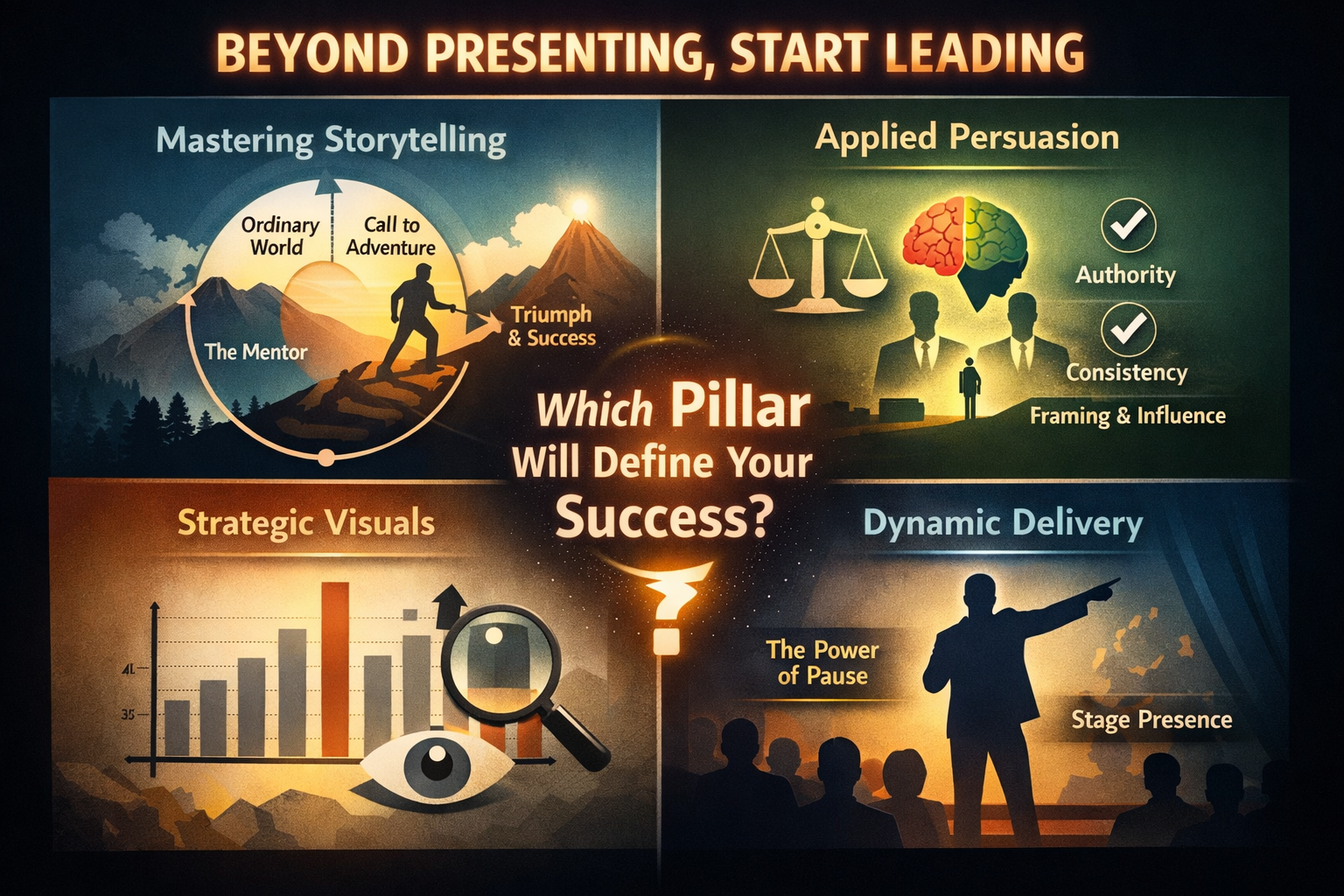
In today’s fast-paced, screen-saturated world, merely presenting data isn’t enough. Your audience is not looking for information; they are looking for transformation. A truly powerful presentation shifts mindsets, changes behavior, and inspires action. This leap from “good” to “inspirational” requires moving beyond the basics and mastering advanced techniques across four key pillars: Narrative Architecture, Applied Persuasion Science, Visual Scaffolding, and Stagecraft Mastery.
Let’s dive into the strategies that separate the speakers who inform from the leaders who inspire.1. Advanced Narrative Architecture: The Power of Emotional Contrast
Storytelling is your most powerful tool, but moving past simple setup-conflict-resolution requires understanding narrative architecture. Your goal isn’t just to tell a story, but to make the audience the Hero of their own journey.The Audience as the Hero
Instead of positioning your company or product as the hero, position your audience and their potential success as the central character. Use the classic Hero’s Journey framework, adapting it for business:- The Ordinary World (The Setup): This is the audience’s current state—the frustration, the slow processes, the missed opportunities. Use vivid language to validate their pain points.
- The Call to Adventure (The Conflict): This is the moment you introduce the potential for change, the looming threat, or the massive opportunity they are currently missing.
- The Refusal: Anticipate the audience’s skepticism (“This sounds too hard,” “We tried this before”). Acknowledge it, and show why this time is different.
- The Mentor (Your Solution): Your product, idea, or strategy is the mentor that guides the hero (the audience) through their challenges.
Mastering Emotional Arcs
Advanced storytelling relies on emotional contrast. Don’t just tell a success story; take the audience on an emotional rollercoaster. Start with the depth of the problem (fear, frustration, loss) before dramatically pivoting to the height of the solution (relief, success, gain). This creates a narrative trough that makes the eventual upswing feel far more impactful and memorable. The shift in emotion is what drives retention. Data as a Character: Stop displaying data points as inert facts. Turn them into actors in your narrative. Instead of saying, “Our churn decreased by 15%,” say, “We found the 15% of customers who were leaving us, and their stories told us exactly where we were failing.”2. Applied Persuasion Science: Guiding Intentional Decisions
Persuasion isn’t manipulation; it’s the ethical use of psychology to align your proposal with the audience’s existing needs and values. Robert Cialdini’s principles provide the foundation, but advanced persuasion involves their strategic deployment.Leveraging Authority and Consistency
- Authority with Subtlety: Don’t just list your credentials. Introduce your authority via a third party (“As the lead analyst on the project, Jane recognized…”) or by referencing recognized industry experts whose opinions your audience already trusts. This avoids sounding arrogant while reinforcing credibility.
- Commitment and Consistency (The Foot-in-the-Door Technique): Seek small, virtually automatic agreements early in the presentation. Start with statements the audience must agree with (“We all agree that efficiency is critical to profitability, right?”). By the time you ask for a major commitment, they have already affirmed a series of smaller, related agreements, making the final ‘yes’ feel consistent with their earlier behavior.
Framing and Cognitive Load
- Strategic Framing: The way you frame a result drastically changes its persuasive impact. Frame your solution not as a cost, but as risk prevention. Studies show that humans are twice as motivated to avoid a loss than they are to achieve an equivalent gain. Frame it as “If we do not implement this, we risk losing $50,000 in the next quarter,” rather than “If we implement this, we will save $50,000.”
- Minimize Cognitive Load: The audience has limited mental bandwidth. Every chart, every dense block of text, drains their capacity. Advanced presenters ruthlessly edit for simplicity, ensuring the audience expends minimal cognitive energy decoding the slide and maximum energy processing the message.
3. Visual Scaffolding: Directing the Eye with Purpose
Visuals must act as a scaffolding that supports, rather than decorates, your message. Advanced visual design uses psychology to control where the audience looks and what they prioritize.Harnessing Pre-Attentive Attributes
The human brain processes certain visual elements before consciousness kicks in. These are called pre-attentive attributes. Master them to instantly guide focus:- Color: Use color only to highlight the one, single, most important data point on a chart. Everything else should be muted gray or a neutral tone.
- Size: Make the key metric 2–3 times larger than peripheral numbers to instantly communicate importance.
- Position: Place the most critical takeaway in the top left or center-right of the screen, where Western audiences naturally focus their attention.
The Data-Ink Ratio and Minimalism
Adopt Edward Tufte’s Data-Ink Ratio principle: Maximize the proportion of ink used for non-redundant data and ruthlessly erase “chart junk.” This means:- Removing unnecessary borders, shadows, 3D effects, and excessive gridlines.
- Directly labeling data points rather than forcing the audience to look back and forth at a legend.
- Embracing high-contrast minimalism where every visual element serves a necessary function, keeping the signal-to-noise ratio exceptionally high.
Visual Pacing
Avoid the temptation to have every slide look like an infographic. Use visual pacing to create a rhythm. Intersperse complex, data-heavy slides with simple, high-impact slides (e.g., a single quote, a powerful image, or a simple headline). This gives the audience’s eyes and mind a necessary rest, ensuring they are mentally fresh for the next detailed visual.4. Inspirational Delivery: Stagecraft and The Mastery of Silence
Delivery is where preparation becomes performance. Advanced delivery techniques go beyond good eye contact and strong posture; they involve controlling the environment and your own non-verbal signals.The Strategic Pause (Kairos)
The most powerful tool in a speaker’s arsenal is silence. A strategic pause, known as Kairos, is not just a breath; it is a punctuation mark used for dramatic effect. Use a long, deliberate pause:- Before a Key Reveal: To build anticipation before delivering the most important sentence.
- After a Critical Statement: To allow the gravity of the point to sink in fully without immediately crowding it with the next sentence.
- To Manage Distraction: If there is sudden noise, pausing and waiting calmly restores the audience’s attention to you.
Stage Movement and Anchoring
Use the physical space of the stage purposefully. This technique, called anchoring, links a physical spot on the stage to a specific idea.- Problem Zone: Stand on the left when discussing the current challenges, pain points, or risks.
- Solution Zone: Move to the center or right when introducing your proposed solution, the vision for success, and the future state.
- Call to Action: Step forward slightly toward the audience when delivering your final, actionable request.
Q&A Mastery (Bridge & Hook)
The Q&A segment is your final opportunity to persuade, not just a time to defend your points. When faced with a difficult or tangential question, use the Bridge & Hook technique:- Acknowledge and Validate (Bridge): “That’s a critical question, and it touches on the potential challenges we face.”
- Pivot to Core Message (Hook): “However, the core of this challenge, as we discussed, is resource allocation. That’s exactly why our Phase Two strategy prioritizes…”
15 thoughts on “Advanced Presentation Techniques to Captivate, Persuade & Inspire”
This post makes a lot of sense as you are appealing to peoples emotional sides and this always seems to work well. You have explained that one has to make the product about who you are trying to sell it to, rather than about yourself or your company. If you can’t convince somebody how the product will benefit them, you will lose the sale.
As storytelling is quite an advanced technique, I think it is something that requires practice as well as trial and error to find out what is going to work for you. I think touching on the challenges that the customer faces is a good way to get started. What is your favorite method to start the ball rolling?
I usually start with a specific, relatable pain point and frame it as a quick “moment” the audience instantly recognizes something that makes them think, “that’s me.”
When it comes to high-stakes environments, do you find that these advanced techniques need to be adjusted significantly for virtual presentations where physical presence is limited, or do the same principles of engagement still hold the most weight? Ultimately, do you believe that the psychological “weight” of a presentation is harder to maintain virtually?
They don’t fundamentally change the core principles of clarity, storytelling, and emotional engagement still carry the most weight but virtually you have to amplify them with tighter structure, stronger visuals, and more deliberate vocal presence.
Hi Kavitha,
This is a really strong presentation strategy. The point about making the audience the hero instead of the speaker or company is something I’ve seen completely change how people respond in meetings. I also like the emphasis on simplicity in visuals. In overall, this is a good reminder that great presentations aren’t just about information, but about shaping how people feel and remember that information. Honestly, this another useful article from you that added more insights inside me. Thank you for this more practical content.
I really appreciate that. Glad the “audience as the hero” idea resonated, it truly shifts everything.
And you’re right, when you simplify visuals and focus on feeling, the message actually sticks.
Presentation skills are something a lot of people overlook, but they make such a big difference in how your message is received. I’ve had to give a few presentations before, and I’ve noticed that confidence and delivery matter just as much as the content itself. Even when the information is good, it doesn’t always connect if the delivery isn’t engaging. I like how you focused on techniques to actually captivate an audience; that’s something I’m still working on.
From your experience, what’s the most effective way to deal with nervousness before presenting? I feel like that’s one of the biggest challenges for a lot of people. Also, do you think storytelling is more impactful than using data when trying to persuade an audience?
Nervousness is best managed through preparation, controlled breathing, and focusing on serving the audience rather than judging yourself.
For persuasion, storytelling grabs attention and creates emotion, while data builds credibility used together, they’re far more powerful than either alone.
Really enjoyed this—especially the idea of visual pacing and using strategic pauses.
I’ve found those same techniques work incredibly well in webinars too. Mixing simple slides with more detailed ones keeps people from zoning out, and those intentional pauses actually seem to boost engagement and retention during live sessions.
Curious if you’ve seen similar results when applying these techniques in longer webinar-style presentations?
Absolutely! I’ve seen those techniques work even more powerfully in webinars, where attention naturally drops faster than in-person sessions. Strategic pacing, slide variety, and pauses help reset focus, increase interaction, and keep viewers engaged for longer.
This is a compelling and well-structured breakdown of what truly elevates a presentation from informative to transformative. I especially appreciate the emphasis on making the audience the hero; this shift alone can redefine how messages are received and acted upon. The integration of persuasion science with ethical intent is also powerful, as it reinforces trust while guiding decisions. Visual scaffolding and cognitive load reduction are practical reminders that clarity always beats complexity. However, for long-term career success, I believe delivery is the most critical pillar. Even the best narrative or visuals can fall flat without confident, intentional execution. Stage presence, pauses, and audience connection ultimately determine how the message lands emotionally. That said, the real strength lies in combining all four pillars cohesively. Mastery isn’t about choosing one, it’s about orchestrating them seamlessly to create impact that lasts beyond the presentation itself.
Thank you for this thoughtful insight. I agree completely that delivery is the bridge that turns strong ideas into real emotional impact, and when combined with the other pillars, that’s where true presentation mastery happens.
This article provides a masterclass in moving beyond the basics of public speaking. I particularly agree with your point about the power of intentional silence; in my opinion, the ability to command a pause is what truly separates a good speaker from a great one. It creates a “theatrical tension” that forces the audience to engage with the material on a deeper level rather than just passively listening.
In my own experience as a corporate trainer, I’ve found that the biggest challenge isn’t the content, but the transition between “presenting” and “connecting.” I used to rely heavily on slides, but once I started incorporating the storytelling techniques you mentioned here, I noticed a significant shift in how much the audience actually retained.
I do have a question regarding the “Advanced Body Language” section: How do you suggest balancing these high-level techniques with the need to remain authentic? Sometimes, when I focus too much on specific gestures or stage movement, I worry it might come across as choreographed rather than genuine. Do you have a tip for making these advanced movements feel like a natural extension of our personality?
Thank you so much for putting together such a high-quality guide—this is an invaluable resource for anyone looking to level up their communication skills!
Good read!. Presentations can feel so scary sometimes. Not just the talking part but hoping people actually listen. And care.
I liked the part about making the audience the hero. That feels more human and less “look at me” and more “this is for you.”
Also the reminder about silence was powerful. I used to think pauses meant I forgot something but now I see they can make the message stronger.
Do you think the emotional side of a presentation matters more than perfect slides?
Absolutely, people usually remember how a presentation made them feel far more than how polished the slides looked. A genuine emotional connection, clear message, and confident delivery often have a bigger impact than perfect visuals alone.